
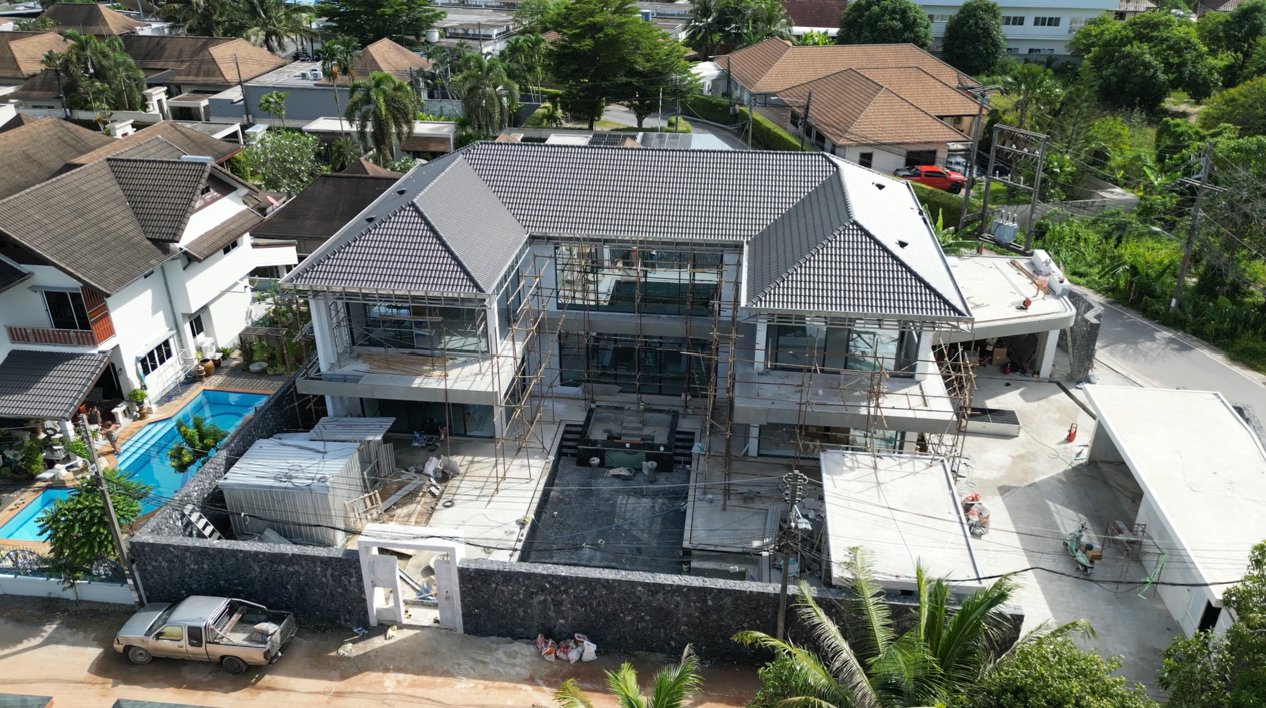
Villa Construction Supervision Phuket: How to Avoid 750K-1.7M THB in Defects
Not from clients—from on-site teams.
- “This drainage slope is 3% instead of 5% as shown on the plans?”
→ “Mai pen rai, we’ll see later.” - “The foundation reinforcement (according to Thai construction standards) is missing 2 transverse bars according to the structural plan?”
→ “Not a problem, we’ll see later.” - “The delivered tiles are 8mm instead of the specified 12mm?”
→ “Same same, we’ll see later.”
“Later” costs between 750K and 1.7M THB (20,000-45,000€) on average.
Here’s the story that illustrates why.
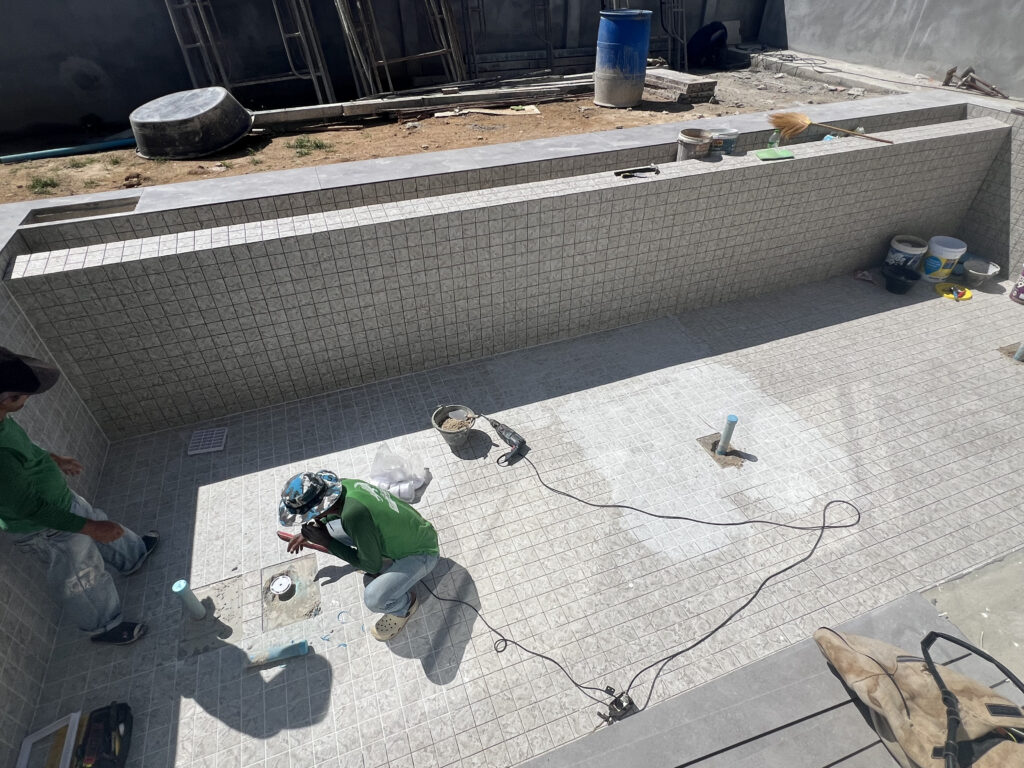
It’s 7:30 AM on a Tuesday morning in Kamala. I arrive at Marc’s construction site for our control visit. Marc is Swiss, first project in Thailand, 22.8M THB (600K€) villa with sea view. Level 2 supervision—scheduled visits at critical phases + triggered interventions.
He’s waiting for me with his phone. “Look.”
WhatsApp photo from his tiler, sent the day before: pool terrace tiling installed, joints done, it’s shining. Looks perfect.
I approach. I take out my measuring tape. Tiles 8mm thick.
Structural plans: 12mm specified.
“Is it serious?” Marc asks me.
Serious? The pool deck was calculated for 12mm tile + setting bed. Tile thickness impacts wear layer rigidity and punching resistance (reinforced concrete structural principles). A slab calculated for 12mm accepts a certain structural deflection; an 8mm tile, less rigid, won’t support it and will crack under load.
In 3-5 years, probable cracks. In 10 years, complete pool deck redo.
Cost to correct now: 161,500 THB (4,250€) (removal, correct reinstallation).
Cost if we wait for cracks: 342,000+ THB (9,000€+) (complete renovation, occupied site).
Marc calls the tiler. “Why not the specified tiles?”
Tiler: “These prettier, thinner, more modern. Mai pen rai, same same.”
There it is. The craftsman’s version of “we’ll see later”.
The tiler isn’t wrong—technically, his work is impeccable. But he didn’t read the structural calculations. Why would he? It’s not his job.
The company’s quality control validated: tiles properly installed, correct joints, level perfect. ✓
But nobody verified: correct tiles according to structural plans?
With our weekly construction supervision service in Phuket (Level 3), I would have been there when the tiles were delivered on site. Detection before installation = 0 THB. With Level 2, detection after installation = 161,500 THB (4,250€).
We removed it the next day. 161,500 THB (4,250€). Marc complained, then paid. The villa sold 18 months later at +9% vs the market thanks to the complete construction portfolio we had assembled (2,847 photos documenting everything that was hidden in the walls).
He thanked me. “Without you, I would never have known. I would have discovered the cracks after the sale, the buyer would have sued me.”
This story, I’ve lived it dozens of times since 2020. Not the exact tile—but this pattern: “we’ll see later” becomes “how much does it cost to fix now?”
The three levels we offer are not comfort options. They are risk management strategies adapted to three different construction site profiles.
Here’s which ones.
The Three Levels of Architect Supervision in Phuket
Level 1: Compliance Control + Payment Milestone Validation
For whom: Standard villa, established company you know, you’re on site regularly.
What we do: 6 fixed visits. Foundations, structure, waterproofing, finishes, reception. I verify compliance vs plans, I write technical report, I list non-conformities to correct.
Critical function: milestone validation for staged payments. You don’t pay the next stage if the current milestone is not compliant. It’s your contractual leverage with the company.
What we do NOT do: Solve problems, redraw, coordinate between my visits, be available outside scheduled checkpoints.
Cost: 152,000-228,000 THB (4,000-6,000€) or 0.8-1.2% construction budget
Typical compliance obtained: 80-85%
(15-20% deviations vs plans, generally minor)
Rawai 2024 Example:
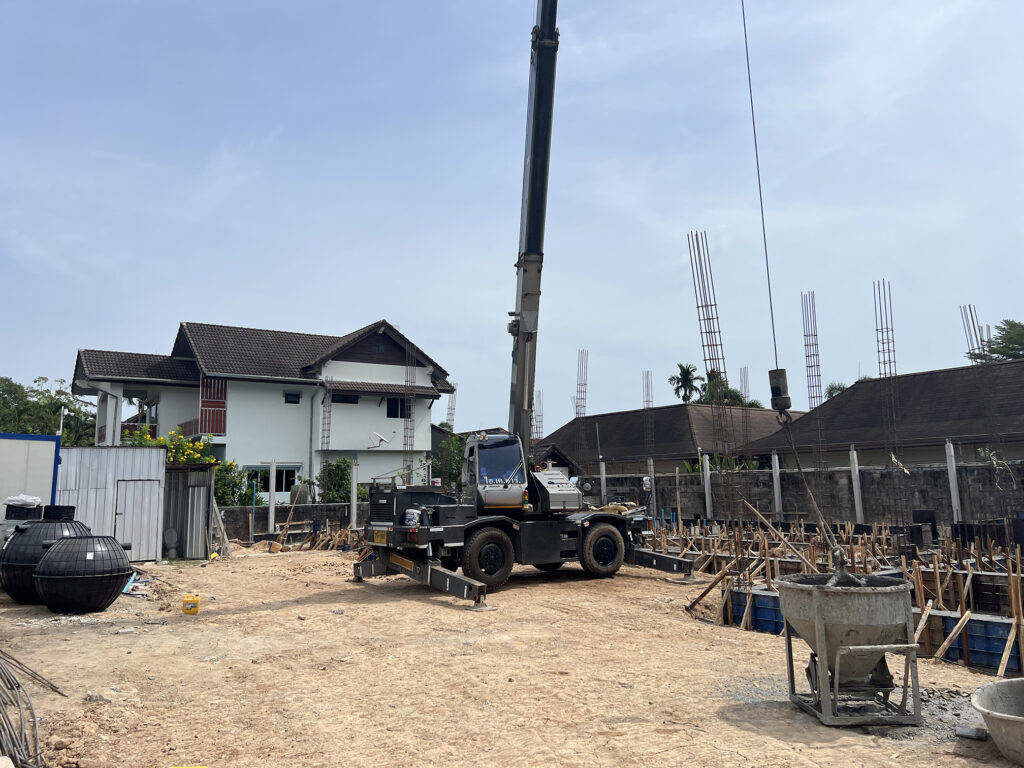
Flat land, classic 3-bedroom villa, company followed for several years. Estimated budget ~19M THB (500K€). Six visits, ~190,000 THB (5,000€), zero major problems. Delivered on time.
Detection rate: ~50% of potential problems
Why only 50%? Because problems occur between visits. But the 50% we catch are the critical moments that condition your payments. Non-compliant foundations = no foundation payment. Incorrect structure = no rough work payment. It’s your contractual protection.
Level 2: Active Supervision + Problem Resolution
For whom: Complex design (slope, sea view, custom geometry), coordination 6-8 trades, you visit monthly.
What we do: 6 scheduled visits + 3-5 additional visits triggered when I detect a problem. I don’t just do the report—I look for the solution with the on-site team. I redraw the problematic details (max 3 graphic interventions). Available phone/email between visits.
What we do NOT do: Weekly coordination all trades, systematic presence, construction schedule management.
Cost: 228,000-570,000 THB (6,000-15,000€) or 1.2-1.5% construction budget
Typical compliance obtained: 88-92%

Kamala 2023 Example:
Villa 420m², 18% slope, complex roof. Estimated budget ~28M THB (737K€). Eleven total visits (6 + 5 triggered). Seven resolution interventions before cost impact:
- Week 9: drainage slope 3% instead of 5% → corrected before slab (avoided 228,000 THB / 6,000€ rework)
- Week 14: MEP routing conflict vs structural beam → redesigned (avoided 152,000 THB / 4,000€ + 2 weeks)
- Week 12: inadequate terrace waterproofing junction → technical detail redone (avoided 285,000 THB / 7,500€ infiltrations)
Total savings: 665,000 THB (17,500€)
Supervision investment: ~380,000 THB (10,000€)
ROI: 1.75x
Marc (tile story) was here. Level 2 = detection after installation. Level 3 = detection before installation.
Detection rate: ~75% of problems
Level 3: Weekly Coordination + Construction Portfolio + Peace of Mind
For whom: Project >750K€ high complexity, you’re based Europe/Asia (rare visits), first Thailand project, multi-craftsman self-construction.
What we do:
Weekly presence (45-50 visits/12 months):
- Weekly meeting all trades
- Conflict anticipation, on-site decision arbitration
- Unlimited real-time redraws
- Permanent interface between you and the site
- Technical dispute management on your behalf
The “invisible” aspect of weekly supervision in Phuket:
From a distance (Europe, Singapore, Hong Kong), you don’t see the daily site conflicts:
- Electrician vs plumber: who runs their conduits first in the false ceiling?
- Tiler vs carpenter: who adjusts their measurements to catch the other’s error?
- Painter vs mason: who redoes the poorly prepared surface?
Without weekly presence, these conflicts come up to you via WhatsApp at 11 PM (time difference). Each party calls you, explains why it’s the other’s fault, asks you to decide. You lose sleep, you make bad decisions under pressure, you pay extras to “catch up”.
With our construction supervision service in Phuket in weekly mode, these conflicts never reach you. I resolve them on site, in real time, with technical authority. The electrician and plumber don’t call me at 11 PM—they wait for the next meeting Tuesday 9 AM.
You buy peace of mind. No panicked WhatsApp. No technical arbitration at 3000km. No craftsman disputes blocking the site for 2 weeks. You receive a clean weekly report: here’s the progress, here’s what’s resolved, here are the two non-technical decisions requiring your validation (color choices, light fixture positioning).
Forensic photographic documentation (2000-3000 images):
Our building inspection service in Phuket in weekly mode is radically different here. The construction portfolio isn’t a “bonus”—it’s your resale insurance.
In Phuket, 70% of international buyers purchase without ever visiting during construction. They buy a finished villa. How do they prove the real quality?
The portfolio documents EVERYTHING that’s hidden before closing:
- Foundation reinforcement (density, spacing, depth)
- Wall insulation (thickness, continuity, fixing)
- Multi-layer waterproofing (application, overlaps, tests)
- Buried drainage (slopes, inspection chambers, outlets)
- Electrical networks (cable sections, protections, routing)
- Plumbing (materials, slopes, ventilations)
- Wood/metal structure (sections, fixings, treatments)
Delivery format:
- Digital archive organized by phase/room/system
- 150-200 page PDF “Construction Quality File”
- Permanent online gallery with timestamped/geolocated metadata
Cost: 427,500-950,000 THB (11,250-25,000€) or 1.5-2.5% construction budget
Typical compliance obtained: 95-98%
(the remaining 2-5% = truly uncontrollable external factors)
Swiss client, villa 650m², 25% slope sea view. Twelve direct subcontractors (no general contractor). Estimated budget ~45M THB (1.18M€).
Forty-seven weekly visits. Twenty-three major interventions avoiding financial impacts:
- Week 4: foundations 1.2m instead of 1.8m (soil report) → adjusted before pouring (avoided 532,000 THB / 14,000€)
- Week 9: insufficient cantilevered terrace reinforcement → redesigned (avoided 665,000 THB / 17,500€)
- Weeks 8, 12, 18: three anticipated and resolved subcontractor abandonments (avoided 456,000 THB / 12,000€ + delays)
Savings: 1,653,000 THB (43,500€)
Supervision investment: ~900,000 THB (23,700€)
Construction phase ROI: 1.8x
But the real impact is at resale.
Detection rate: ~95% of problems
The Resale Argument: Why Construction Portfolio is Critical
Real scenario in 2025:
Rawai villa 26.6M THB (700K€), 4 years old, French client selling to return to France.
– Without construction portfolio:
Potential buyer (German): “How do I verify insulation quality? Waterproofing networks? I can’t open the walls.”
Seller: “The company told me everything is compliant.”
Buyer: “I want 10% reduction for hidden risk or I pass.”
Final negotiation: -8% (2.13M THB / 56,000€)
– With construction portfolio (real neighboring villa case, same year):
Potential buyer (Swedish): “How do I verify construction quality?”
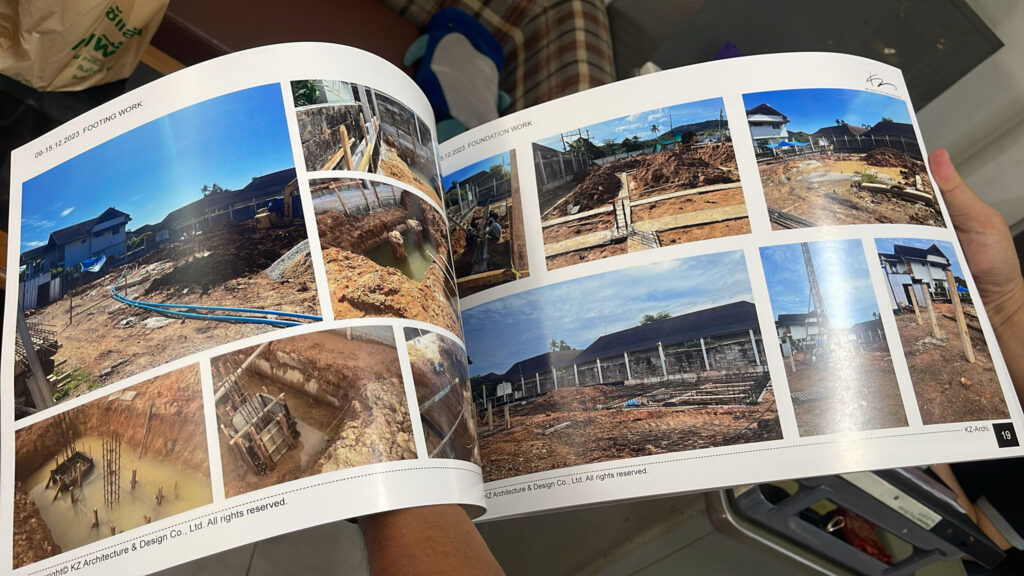
Seller: “Here’s the portfolio 2,847 photos. Pages 67-73: complete insulation installation with material specifications. Pages 112-156: multi-layer waterproofing with pressure tests. Pages 201-234: complete MEP networks before closing. Architect validation each phase.”
Buyer (30 minutes later): “I want this villa. Full price offer.”
Premium achieved: +9% (2.4M THB / 63,000€) vs villa without documentation.
Based on our experience with luxury villa resales in Phuket, range 22.8-34.2M THB (600K-900K€), Rawai/Chalong/Nai Harn:
| Metric | With portfolio | Without | Difference |
|---|---|---|---|
| Days on market | 67 days | 143 days | -53% |
| Price vs initial asking | -2.8% | -11.4% | +8.6 pts |
| Premium vs comparables | +9.3% | 0% | +9.3% |
On a 28.5M THB (750K€) villa:
Portfolio = ~2.66M THB (70,000€) higher price + 76 days faster transaction
Complete Level 3 ROI (construction + resale):
| Value | Amount THB | Amount EUR |
|---|---|---|
| Supervision cost | 570,000 THB | (15,000€) |
| Construction corrections avoided | 1.33M THB | (35,000€) |
| Resale premium (conservative) | 1.9M THB | (50,000€) |
| Transaction time value | 285K THB | (7,500€) |
| Total value generated | 3.505M THB | (92,500€) |
| Net ROI | 6.1x | |
The portfolio isn’t marketing material. It’s forensic proof that the international buyer cannot obtain otherwise.
What Nobody Measures (And We Measure)
Most projects track budget and timeline. Almost nobody measures design vs constructed reality compliance rate.
Our metric: (Elements built exactly as planned ÷ Total specified elements) × 100
Phuket market observations based on our villa architect supervision experience:
| Supervision | Typical compliance |
|---|---|
| Without architect supervision | 55-70% |
| Level 1 (checkpoints) | 80-85% |
| Level 2 (active) | 88-92% |
| Level 3 (weekly) | 95-98% |
Why does a 5-10% gap = 750K-1.7M THB (20,000-45,000€)?
Non-conformities group into three categories:
Structural (minority of problems, majority of cost):
Insufficient reinforcement, incorrect drainage slopes, wrong beam sections.
Correction cost: 285,000-855,000 THB (7,500-22,500€) depending on detection timing.
Materials (about half of problems):
FSC teak → “similar tropical wood”, premium waterproofing → standard, brand substituted without validation.
Correction cost: 152,000-475,000 THB (4,000-12,500€) (removal, replacement, delay).
Technical (other half):
Sub-optimal MEP routing, insulation gaps, undersized ventilation for tropical climate.
Correction cost: 95,000-380,000 THB (2,500-10,000€) (compromised performance, future energy bills).
→ Tropical climate construction standards (Building and Construction Authority Singapore)
The 6 Critical Moments of Villa Construction in Phuket
Majority of detectable structural problems emerge weeks 4-9 (foundations → structure).
→ About 1/3 of detectable problems originate here.
2. Mid-foundations (W4-5)
Reinforcement density/placement, depth vs soil report, anti-seismic Zone 2A.
→ About 1/4 of structural problems.
3. Pre-waterproofing (W8-10)
Structural concrete, MEP reservations, prepared surfaces.
→ About 20% of critical problems.
4. Post-waterproofing (W12-14)
System integrity, tests, critical junctions, drainage outlets.
→ About 10% of major problems.
5. Pre-finishes (W20-22)
Prepared surfaces, MEP tested, insulation installed.
→ Some adjustments.
6. Pre-reception (W35-40)
Overall compliance, finish quality, commissioned systems.
→ Final minor corrections.
→ Thailand seismic construction standards (Department of Public Works and Town & Country Planning)
→ Our critical phase inspection methodology
Architect Inspection vs Contractor Quality Control
Common question: “The company has internal QC, why pay an architect extra?”
Complementary functions, not redundant:
Architect inspection verifies: Validated design compliance (correct specifications, correct plan interpretation, global concept impact).
Marc’s pool tile story:
- Internal QC: ✓ correct installation, proper joints
- Architect inspection: ✗ wrong specification (8mm vs 12mm structural calculation)
Both necessary. Different scopes.
→ Independent construction inspection principles (American Society of Home Inspectors)
Which Level For Your Villa?
| Criterion | Level 1 | Level 2 | Level 3 |
|---|---|---|---|
| Construction budget | <19M THB (<500K€) | 19-38M THB (500K-1M€) | >28.5M THB (>750K€) |
| Complexity | Standard | Custom | High |
| Thailand experience | 2nd+ project | 1st with support | 1st project |
| Site presence | Weekly+ | Monthly | Rare (Europe/Asia) |
| Resale priority | Secondary | Important | Critical |
| Stress tolerance | Can handle disputes | Occasional support | Zero craftsman conflicts |
No universal solution. Depends on real project characteristics.
→ View our detailed supervision pricing
What Architect Supervision Does NOT Solve
Necessary transparency:
1. Incompetent on-site team
I detect, recommend, validate corrections. I don’t transform bad craftsmen into experts.
2. Flawed design conception
Supervision reveals design problems. Requires design rework, not reinforced supervision.
3. Insufficient budget
I quantify real costs. Don’t add money to client account.
4. Chronic client indecision
Design changes during construction = +8-12 weeks systematically, supervision or not.
Some projects in our experience had to stop despite supervision (budget exhausted, land disputes, client circumstances).
Level 3 significantly reduces abandonment probability—doesn’t eliminate it.
Real ROI By Level
Based on Phuket villa project experience (budgets 12.35-47.5M THB / 325K-1.25M€):
Level 1
ROI ~2x
(1 THB supervision → ~2 THB saved)
Level 2
ROI ~2-3x
(1 THB supervision → ~2-3 THB saved)
Level 3
ROI ~6x including resale
(1 THB → 6 THB total value)
- 30% different (no supervision)
- 15% different (Level 1)
- 10% different (Level 2)
- 4% different (Level 3)
For majority of Phuket villa projects: Level 2 optimal. Cost-benefit balance.
Kaled Kamala, founding architect, is registered with the Ordre des Architectes in France (Paris), DPLG graduate from Paris-Val-de-Seine School of Architecture (2004).
Structure and Site Organization Assessment (Free)

Not a generic evaluation. Precise technical assessment:
I analyze:
- Budget vs real design complexity
- Existing/planned site organization
- Project-specific risks (slope, sea view, complex MEP)
- Your site presence vs construction timeline
- Resale documentation priority
Deliverable: Supervision level recommendation with technical justification. No sales pressure. If your project doesn’t need supervision, I tell you.
Process:
- Project brief → 48h
- Assessment call 30 min
- Written recommendation → 72h
Contact: info@kz-archi.com
Subject: “Construction Assessment – [Location]”