
Most developers who contact us assume we only design villas in Phuket. It makes sense – Phuket has become one of the most active residential development markets in Thailand, and the architecture market here revolves around individual homes. That is a big part of what we do. But over the past five years, a growing share of our work has involved multi-unit developments: condominiums, apartment complexes, mixed-use projects. Working with a condominium architect in Phuket familiar with large residential developments is essential – because the challenges have almost nothing in common with villa design.
The question we hear most from developers considering their first large-scale project is simple: “Can’t I just repeat a good villa plan 100 times?” The short answer is no. The long answer is this article.
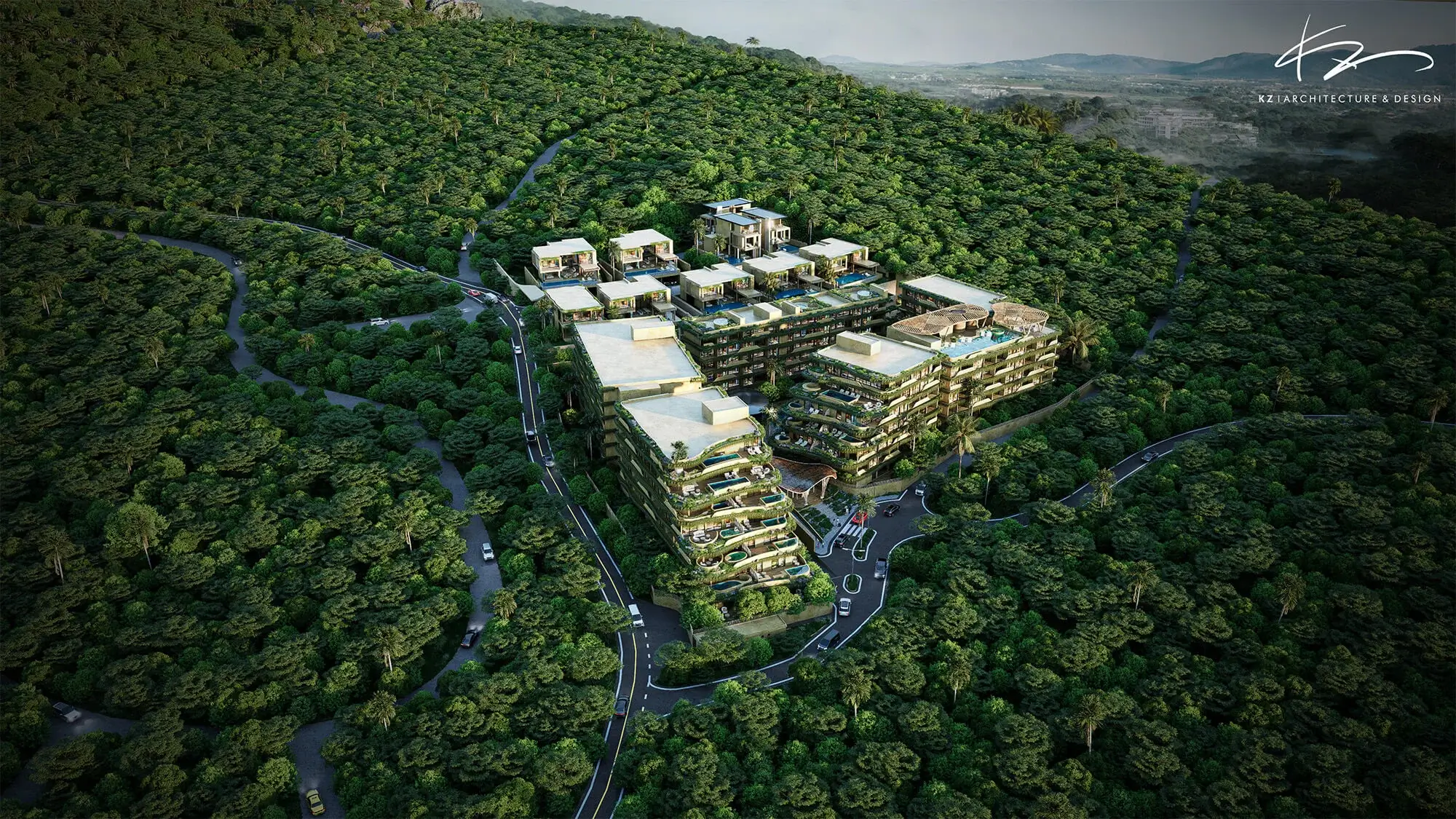
Designing a 100+ unit condominium is a fundamentally different discipline from designing a single villa. The regulations change. The engineering changes. The way you think about climate, drainage, parking, and even sunlight changes. Here is what we have learned from one of our Phuket condominium projects, Shaanti Hillview – a 254-unit residential complex spread across five buildings with 43,000 m2 of construction area and underground parking infrastructure, located in Layan, Phuket – and why it matters for your next investment.
In this article
- EIA, Permits, and Condominium Law in Phuket
- Structural Engineering Challenges in Phuket Condominium Projects
- Condominium Infrastructure Systems: Plumbing, Drainage, Ventilation
- Bioclimatic Architecture at Scale: Cooling 254 Units
- Terrain Constraints: Building on Slopes, Preserving Forest
- The Role of an Independent Architect on Large Projects
- Scaling Architecture Is Not Scaling Plans
- Frequently Asked Questions
A Different Regulatory World: EIA, Permits, and Condominium Law in Phuket
A villa in Phuket requires a standard building permit. The process is straightforward: submit plans to the local Tambon Administrative Organization or Municipality, wait for review, receive approval. For a single residential structure, this typically takes 2 to 4 months.
A condominium changes everything.
Environmental Impact Assessment (EIA) Requirements
In Thailand, residential projects typically require an Environmental Impact Assessment when they exceed around 80 units or 4,000 m2 of total floor area, depending on project classification and zoning regulations. The EIA is not a formality. It is a detailed study covering noise, traffic, waste management, water treatment, and ecological impact. It requires licensed environmental consultants, public hearings, and approval from the Office of Natural Resources and Environmental Policy and Planning (ONEP).
In Phuket and other sensitive coastal areas of Thailand, the EIA process for a residential project typically takes 10 to 18 months from initial submission to final approval.
We integrate EIA requirements from the earliest sketch phase. Why? Because once you file an EIA, the number of units, building footprints, and structural layout are locked. If you need to change them afterward – add 20 units, shift a building, adjust a floor count – you refile the entire study. We have seen developers accept this on the assumption that the delay cost will be absorbed by the project’s profitability. Sometimes it works out. Often, it means 6 to 12 additional months of holding costs on land that generates zero revenue.
For a mid-size project in Phuket, land holding costs during delays can easily reach 100,000 to 300,000 THB per month depending on financing structure. The lesson is simple: get the design right before the EIA filing, not after.
Typical condominium project timeline in Phuket:
- Feasibility study: 1-2 months
- Concept design: 2-3 months
- EIA preparation: 4-6 months
- EIA approval: 6-12 months
- Construction permit: 2-4 months
Condominium Act and Registration
Beyond the building permit, condominium projects in Thailand must comply with the Condominium Act B.E. 2522. This governs unit ratios, common area definitions, foreign ownership quotas (maximum 49% of total sellable area), and management structures. These legal constraints directly shape architectural decisions: the ratio of common to private space, corridor widths, fire escape distances, elevator capacity.
For a villa, none of this exists. For a condo, it shapes every floor plan.
Small-Scale Condominiums: When EIA Does Not Apply
Not every condominium triggers an EIA. Projects under 80 units and 4,000 m2 follow a simpler permit path – closer to villa permitting but with additional structural and fire safety requirements for multi-story construction. We have seen condominium projects built on less than one rai of land. The regulatory burden scales with project size, which is precisely why architectural planning from the start determines whether you end up with a straightforward permit process or an 18-month administrative cycle.
Our condominium architecture services in Phuket include full permit management, from initial feasibility through final approval. For a detailed walkthrough, see our guide to the building permit process in Phuket.
Structural Engineering Challenges in Phuket Condominium Projects
A typical Phuket villa sits on isolated footings or a raft foundation. The structural calculations are relatively contained: you are dealing with one or two floors, limited spans, and predictable load paths.
A multi-story condominium with underground parking is a different structural universe.
Foundation Systems and Underground Construction
On Shaanti Hillview, we designed 6,390 m2 of underground parking beneath five residential buildings on sloped terrain in Layan. This required deep foundation systems, reinforced retaining walls, and controlled mechanical ventilation to prevent humidity infiltration – a critical issue in Phuket’s tropical marine climate where underground structures can become condensation traps within months.
A villa’s foundation budget might represent 8-12% of total construction cost. On a condominium with underground structures, industry estimates in Thailand place this at 18-25%, depending on soil conditions and water table depth. Underestimating this line item is one of the most common financial miscalculations developers make on their first large-scale project.
Many first-time developers underestimate the structural budget because they extrapolate villa construction costs to large condo developments. The logic seems sound – multiply a villa’s cost per square meter by the total area. In practice, it ignores the exponential increase in foundation depth, structural reinforcement, and infrastructure challenges typical of large condo developments in Phuket.
Seismic Design for Multi-Story Structures
Phuket falls within Thai seismic Zone 2A standards. For a two-story villa, seismic considerations are relatively minor – standard reinforcement detailing usually suffices. For a five-story condominium with 254 units and underground parking, anti-seismic design becomes a primary structural constraint.
This means moment-resisting frames, specific reinforcement detailing at beam-column joints, and in some cases, shear walls strategically placed to resist lateral forces. The structural engineer is not a consultant you call at the end. They work alongside the architect from day one.
Fire Safety and Evacuation Design
Multi-story residential buildings must comply with strict fire safety regulations in Thailand. This includes protected staircases, smoke extraction systems, fire-rated corridors, and emergency evacuation distances. These requirements significantly influence floor plan efficiency and circulation design. On a villa, fire safety is a minor consideration. On a condominium, it can determine whether a floor plan works or needs to be redesigned from scratch – and it is reviewed during the permit process.
Condominium Infrastructure Systems in Phuket: Plumbing, Drainage, and Ventilation at 100+ Units
In a villa, you install one water heater, one septic system, one set of downpipes. If something fails, one household is affected. In a condominium, every technical system is collective – and failure cascades.
Centralized Water Management
A 254-unit development produces volumes of greywater that cannot be handled by individual septic tanks. Integrated greywater treatment systems and rainwater harvesting become engineering necessities, not green marketing features. On Shaanti Hillview, the rainwater collection system was designed specifically for Phuket’s monsoon patterns – capturing peak flows from May through October while managing overflow during extreme rainfall events.
For the developer reading this: centralized water management adds cost upfront, but reduces long-term maintenance expenses per unit and satisfies increasingly strict EIA requirements. It is not optional on projects above 80 units.
Mechanical Ventilation in Underground and Common Areas
Phuket’s average humidity exceeds 80% for six months of the year. Underground parking without controlled mechanical ventilation becomes a mold incubator. Common corridors without adequate air movement accumulate heat. Elevator shafts without pressure management create thermal chimneys.
These are problems that simply do not exist in villa architecture. In condominium design, HVAC engineering is structural – it shapes shaft locations, floor-to-floor heights, and facade openings from the first sketch.
Bioclimatic Architecture at Scale: Cooling 254 Units Without Mechanical Dependency
We have written extensively about passive cooling for villas. Cross-ventilation, roof overhangs, strategic orientation – these principles work well at the individual building scale. But applying them to a multi-building, multi-story development requires a completely different level of analysis.
Orientation and Wind Flow Across Multiple Buildings
On a single villa, you orient the building to capture prevailing winds and minimize western sun exposure. On a five-building complex, you must consider how each building affects airflow to the next. Wind shadow effects, heat island formation between structures, and reflected solar radiation from adjacent facades all become design variables.
At Shaanti Hillview, the terraced arrangement along the natural slope was not an aesthetic choice. It was an airflow strategy – each building sits at a different elevation, preventing the upstream structure from blocking ventilation to the one below.
Green Facades as Measured Thermal Performance
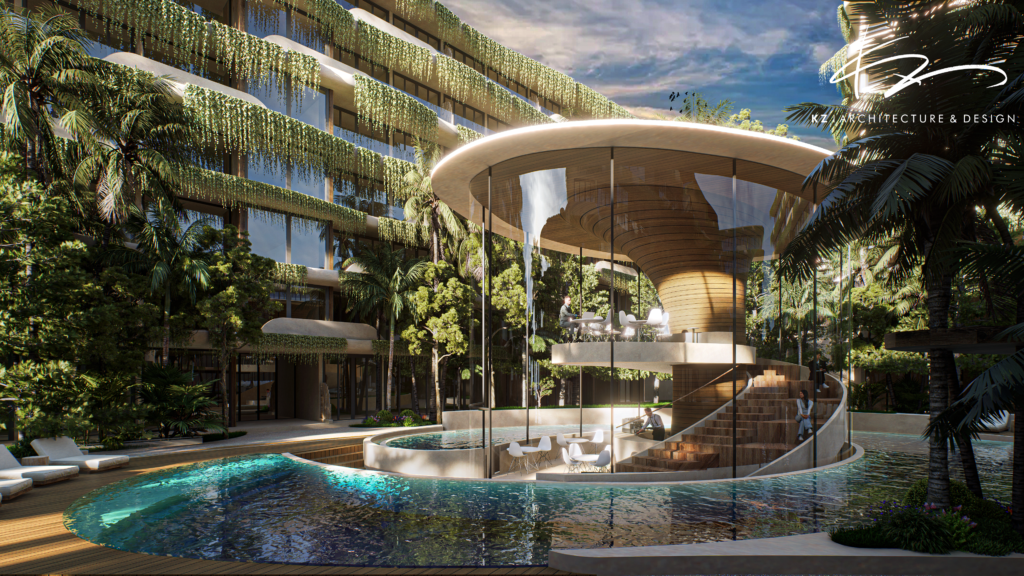
The self-irrigating green facades on Shaanti Hillview have shown observed temperature reductions of approximately 3-5 degrees Celsius in comparable tropical conditions through evaporative cooling. On a single villa, you might achieve similar results with deep overhangs and mature trees. On a condominium with hundreds of meters of exposed facade, green wall systems become a quantifiable thermal strategy – not decoration.

The key word is “self-irrigating.” In Phuket’s climate, a green facade that requires manual maintenance across five buildings will be abandoned within two years. The irrigation system must be integrated into the building’s water management from the outset.
For more on climate-responsive design in Phuket, see our analysis of 2026 architecture trends.
Terrain Constraints: Building on Slopes, Preserving Forest
Phuket’s remaining developable land is increasingly sloped, forested, or both. Flat coastal plots are either built out or priced beyond feasibility for new development. This pushes condominium projects onto terrain that demands specific engineering expertise.
Slope Construction and Terraced Design
Shaanti Hillview sits on 11,319 m2 of sloped forest terrain. Building five residential structures on this site required three-phase construction sequencing to minimize erosion, maintain site access throughout the build, and preserve the surrounding vegetation.
A villa on a slope is a contained challenge. A condominium on a slope multiplies every variable: retaining wall lengths, drainage volumes, access road grades, and construction logistics. Each building must be independently accessible by emergency vehicles while the overall site maintains pedestrian connectivity. This is civil engineering layered on top of architecture.
Environmental Preservation in High-Density Development
The project maintains 60% of existing forest canopy while accommodating 254 residential units. This was not a marketing decision – it was a regulatory and design constraint that shaped every aspect of the masterplan: building footprints, setbacks, construction zones, and material staging areas.
For developers: forest preservation on this scale is achievable, but it requires an architect who plans the construction process as carefully as the buildings themselves. Canopy loss during construction is irreversible. You cannot replant a 30-year-old tree.
See our terrain feasibility case study for a concrete example of how site conditions shape project viability.
What This Means for Developers: The Role of an Independent Architect on Large Projects
On a single villa, some owners choose to work directly with a contractor who provides in-house design. We have written about the hidden costs of that approach. On a condominium project, the stakes multiply.
A multi-unit development involves coordination between the architect, structural engineer, MEP (mechanical, electrical, plumbing) consultants, environmental consultants, landscape architects, and the contractor – often simultaneously. The architect’s role is not just to draw plans. It is to ensure that the structural engineer’s column placement does not conflict with the MEP engineer’s shaft locations, that the landscape architect’s grading does not undermine the civil engineer’s drainage, and that all of it complies with the EIA commitments filed months earlier.
On a villa, one person can hold all of this in their head. On a 254-unit development, it requires systematic coordination – and an architect who has done it before.
Cost Structure: Architecture Fees on Large-Scale Projects
Here is something developers often discover too late: the architectural fee as a percentage of total construction cost is lower on a condominium than on a villa. A villa typically carries an architectural fee of 6-8% of construction cost. A 100+ unit condominium, because of economies of scale in repeated floor plans, typically sits at 4-7%.
The absolute number is larger, but the per-unit cost of professional architectural services is significantly lower. And on a project where a permit delay or an EIA refiling costs tens of thousands of baht per day in holding costs, the return on that investment is measurable.
For a detailed breakdown, read what you actually pay for in architecture fees.
This is why developers working in Phuket increasingly involve architects early in the process – often before land acquisition – to verify density potential, regulatory feasibility, and construction viability.
Scaling Architecture Is Not Scaling Plans
The gap between designing a villa and designing a condominium is not one of size. It is one of discipline. Different regulations, different engineering, different climate strategies, different coordination demands. A good villa architect is not automatically a good condominium architect. The skills overlap, but the complexity does not scale linearly – it compounds.
We know this because we work on both – in Phuket and across Southeast Asia. The principles are the same: climate-responsive, technically rigorous, adapted to local constraints. The application is fundamentally different.
Large residential developments require a completely different architectural methodology than private villas. A condominium is not 100 villas stacked together. It is an integrated urban system.
If you are considering a condominium or multi-unit residential project in Phuket, we recommend starting with an early feasibility study. This allows developers to validate density, regulatory constraints, and structural strategy before committing to land acquisition or EIA submission. Contact us at info@kz-archi.com or through our contact page to start the conversation.
Frequently Asked Questions
Do I need an architect for a condominium project in Phuket?
Yes. Thai building regulations require licensed architectural and engineering drawings for any structure exceeding two stories or specific floor area thresholds. Beyond legal compliance, a condominium involves EIA coordination, multi-system integration, and regulatory complexity that requires professional architectural management. A licensed architect signs the permit drawings and takes professional liability for the design.
What is the difference between designing a villa and a condominium in Thailand?
The core differences are regulatory (EIA requirements above 80 units or 4,000 m2, Condominium Act compliance, fire code for multi-story buildings), structural (deep foundations, seismic design at scale, underground parking), and technical (centralized water treatment, mechanical ventilation, collective MEP systems). A villa is a self-contained design problem. A condominium is a systems integration challenge.
How much does an architect charge for a condominium project in Phuket?
Architectural fees for large-scale residential projects in Phuket typically range from 4-7% of construction cost, depending on project complexity, site constraints, and scope of services. This is proportionally lower than villa architecture fees (6-8%) due to economies of scale in repeated unit layouts. The fee covers design, permit documentation, EIA coordination, and construction supervision.
What triggers an EIA requirement for a residential project in Phuket?
In Thailand, an Environmental Impact Assessment is typically required for residential projects exceeding around 80 dwelling units or 4,000 m2 of total floor area, depending on project classification and zoning. The EIA process involves environmental studies by licensed consultants, public hearings, and approval from ONEP. Critically, once an EIA is filed, unit counts and structural layouts are locked – any significant change requires refiling the entire study. We recommend finalizing design decisions before EIA submission to avoid costly delays.
Can a condominium be built on less than 1 rai in Phuket?
Yes. Not every condominium requires a large site. Smaller-scale projects under 80 units and 4,000 m2 do not trigger EIA requirements and follow a more streamlined permit process. The feasibility depends on local zoning, building height restrictions, and FAR (Floor Area Ratio) allowances for the specific location. An early feasibility study determines what is buildable on any given plot.
Designing a condominium is not only about creating attractive architecture.
It is about controlling complexity, regulations, and long term financial performance.
About KZ Architecture & Design
KZ Architecture & Design is a French-led, licensed architecture firm based in Phuket, Thailand, specialised in high-end villa design and integrated Design & Build execution for European and international investors.
- Founded by Kaled Kamala, French architect, Paris-Val-de-Seine School of Architecture (2004)
- Specialised in architecture and risk reduction since 2008
- Based in Phuket since 2020
- 20 years of international experience, including 12 years in Asia
- Licensed architecture firm operating across Thailand
- Serving European and international investors building in Phuket and Southeast Asia
- Integrated Design & Build structure: design, documentation, construction coordination under one responsibility
Before launching a condominium project in Phuket, request a Pre-Development Architectural Review.
We analyse your concept, verify regulatory feasibility, identify structural and financial risks, and evaluate the architectural efficiency of your project before design development begins.
To maintain analytical precision, we accept a limited number of project reviews each month. We also limit the number of condominium projects we engage in each year to ensure full architectural and technical oversight.
Request your Technical Review here →
info@kz-archi.com — Response within 24–48 hours.
Written by Kaled Kamala, Founder of KZ Architecture & Design. French architect graduated from Paris-Val-de-Seine School of Architecture, specialised in architecture and risk reduction since 2008. Based in Phuket since 2020, with 20 years of international experience including 12 years in Asia across Europe, South America, the Caribbean, India and China.