
Land Titles, Zoning, and Feasibility — The Complete Guide (2026)
How do you know whether a plot is actually buildable before you buy it?
Written by Kaled Kamala — Founder, KZ Architecture & Design · Architect DPLG · Updated July 2026
You’ve found the plot. The agent calls it “almost a Chanote.” Your lawyer hasn’t seen the title yet, but the seller wants a deposit this week. Six documents can be called a “land title” in Thailand. Only two of them offer strong legal protection. And even with the right title in hand, a foreigner cannot legally hold the land in their own name, a second layer of complexity most listings leave out entirely. Buying land in Phuket requires verifying far more than the land title itself.
Scope note: this guide covers land title verification, zoning and altitude restrictions, foreign ownership structures, and how they interact with the building permit process in Phuket. It applies primarily to private villa and small residential/commercial land purchases. Large-scale condominium and resort developments involve additional regulatory layers (EIA, ONEP coordination) not covered in depth here.
Three assumptions to correct upfront
“I have a Chanote, so I can build.” Not necessarily. A Chanote secures ownership, not buildability. Zoning, altitude, access, and easements apply regardless of title type.
“A Nor Sor 3 Gor is a bad title.” No. It’s a legally solid possessory right, a legal claim to occupy and use land, short of full ownership common across Phuket, and upgradable to Chanote. The risk isn’t the title itself; it’s buying without understanding what it implies.
“A 30+30+30 lease is guaranteed.” No. Only the first 30-year term carries binding legal weight. The Supreme Court struck down this type of clause against third parties in March 2025.
Why some land is impossible to build on despite a valid title
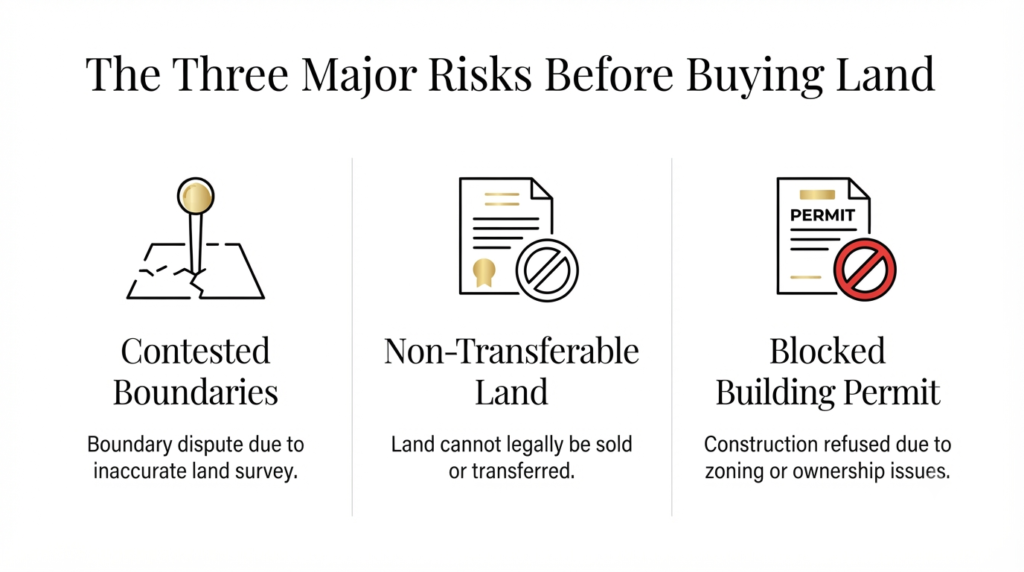
Confusion between title types and skipped buildability checks generate recurring losses in Phuket
transactions: contested boundaries after purchase, land that cannot legally be sold or transferred, permits
blocked by the Land Department or the local administration (OrBorTor), and projects halted mid-construction
over zoning or ownership-structure issues. None of this shows up during a casual site visit; it surfaces
during due diligence, or worse, after construction has started.
The KZ verification method
Applied during the feasibility phase, before any design work begins. The rest of this guide walks through
each of these seven checks in detail.
- Land title — document type, ownership chain, registered encumbrances
- Cadastral survey — consistency between declared boundaries and the official survey
- Zoning and altitude — EPRA, permitted height, coastal setback, slope
- Access and easements — registered right-of-way, road width, available utilities
- Ownership structure — compliance of the acquisition structure (lease, company, usufruct)
- Architectural feasibility — consistency between the intended project and the constraints identified in steps 1-5
- Permit submission—OrBorTor application built on the validated points above
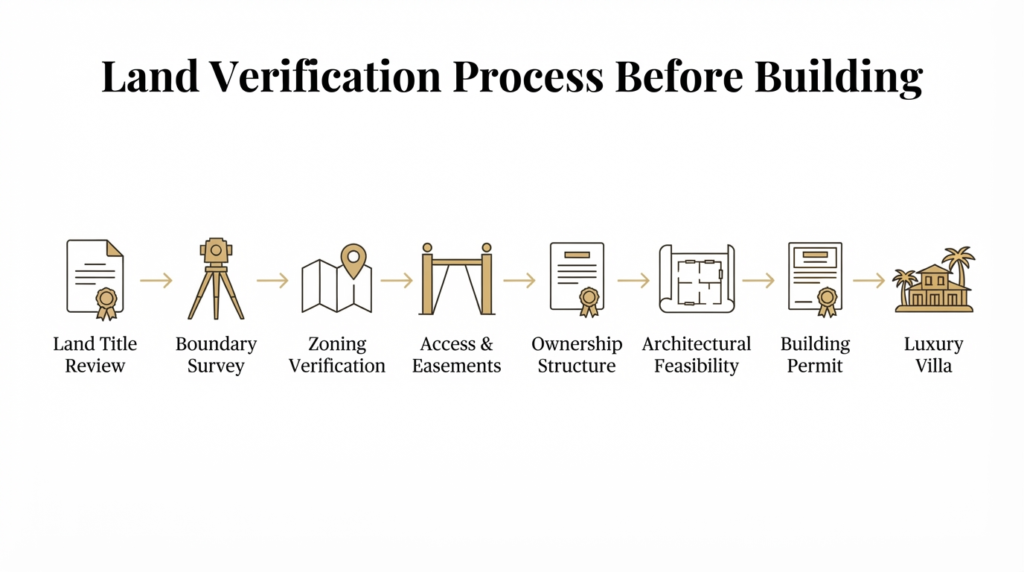
A successful project starts with proper due diligence, including title verification, legal structure, planning compliance, and architectural feasibility before applying for a building permit.
In practice, this means every land question in this guide eventually feeds back into a design decision where the villa sits on the plot, how it’s oriented, and what can realistically be submitted for a permit.
What’s the difference between a Chanote and a Nor Sor 3 Gor?
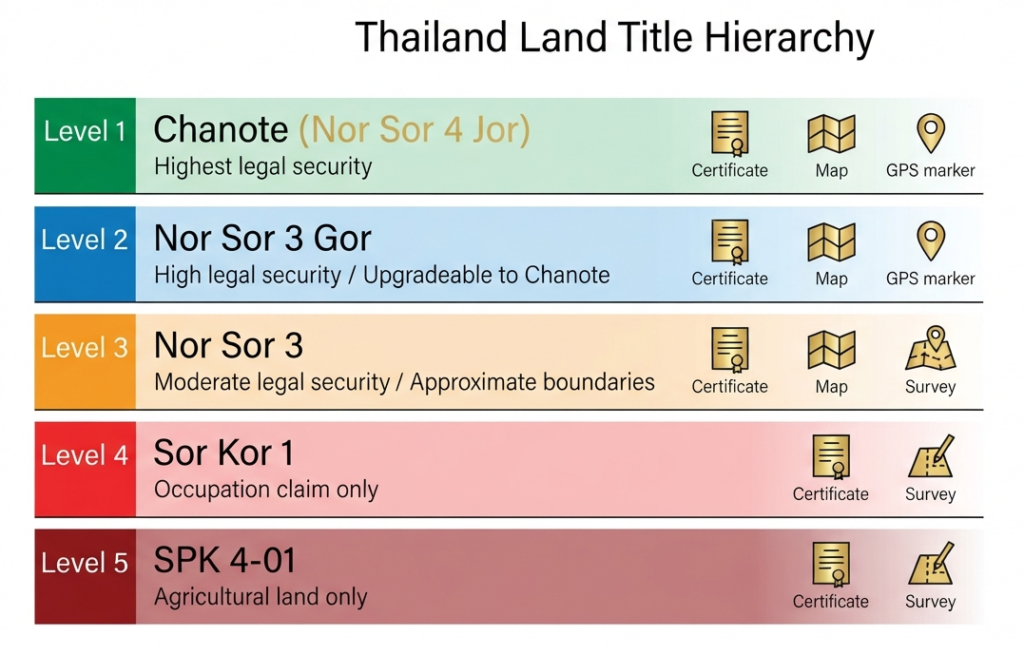
Not all Thai land titles provide the same legal security. Chanote offers the highest level of ownership certainty, while other titles may involve additional legal or surveying requirements.
The Land Code Act, administered by the Department of Lands, recognizes several tiers of land rights. The two titles generally offering the highest legal security are the Chanote and the Nor Sor 3 Gor.
What is a Chanote? A Chanote is Thailand’s highest level of land ownership title, providing GPS-surveyed boundaries and unrestricted ownership transfer.
What is a Nor Sor 3 Gor? A Nor Sor 3 Gor is a possessory land right with boundaries set by an official aerial survey, legally solid and upgradable to a Chanote.
| Title | Legal security | Construction | Resale / transferability | Upgrade |
|---|---|---|---|---|
| Chanote | High | No title-related restriction | Free | — |
| Nor Sor 3 Gor | High | Generally possible | Free, no 30-day notice | To Chanote (6-12 months)* |
| Nor Sor 3 | Moderate | Permit-blocking risk | 30-day notice required | To Chanote (12-24 months)* |
| Sor Kor 1 | Low | Not recommended | Not transferable (inheritance only) | Court procedure |
| SPK 4-01 | None for a foreigner | Prohibited (agricultural use) | Not transferable to a foreigner | Not applicable |
* Timelines and costs based on recent KZ Architecture & Design projects in Chalong, Rawai, and Kathu — not an official figure published by the Department of Lands.
Chanote (Nor Sor 4 Jor / น.ส.๔ จ.)
Full freehold ownership. GPS-surveyed boundaries, registered by the provincial land office. Transferable,
mortgageable, inheritable without restriction. Maximum legal security, backed by official cadastral
markers — and the rarest title on undeveloped hillside land in Phuket.
Nor Sor 3 Gor
A possessory right with boundaries set by official aerial survey (1:5000 scale), linked to the national cadastral network. Exempt from the 30-day public notice period required for standard Nor Sor 3 transfers, allowing immediate registration at the Land Office. Upgradable to Chanote through ground survey verification.
Nor Sor 3
A possessory right with approximate boundaries based on neighboring plots, without physical markers. Any transfer requires a 30-day public notice period. Boundary disputes are common.
Sor Kor 1
An occupation declaration dating from 1954. Not a title of ownership. Cannot be sold or transferred. If this is the only document on a plot, walk away from the deal.
SPK 4-01 (Sor Por Kor)
Reserved for qualified Thai farmers under agricultural land reform (ALRO). Cannot be sold, leased to a foreigner, commercially mortgaged, or used for non-agricultural construction including plots marketed as
“agricultural Chanote.”
Why so much land in Phuket is still held under Nor Sor 3 Gor
Across the hillside areas most sought after for villa projects Kamala, Surin, Bang Tao, Kata, Karon,
Chalong and Rawai, significant shares of land, have never been upgraded to Chanote. Two structural reasons: final conversion requires a GPS ground survey that the Department of Lands schedules according to its own local workload, not the landowner’s request; and part of this land sits within altitude zones governed by
the Environment Protection Regulation Announcement (EPRA), where environmental review slows every
administrative process, including title upgrades. Nor Sor 3 Gor remains the norm rather than the exception
in these areas, which isn’t a problem in itself, provided the title is properly verified before purchase.
Zoning and altitude: what the land title doesn’t tell you
A valid title doesn’t authorize anything on its own. Buildability depends on a stack of separate
regulations, administered by different authorities: the Ministry of Natural Resources and Environment for
environmental zoning; the Department of Public Works and Town & Country Planning for land-use zoning; and the local OrBorTor for permit processing under the Building Control Act B.E. 2522.
Altitude zones (EPRA)
What is EPRA? The Environment Protection Regulation Announcement is the Ministry of Natural Resources and Environment directive that restricts construction by altitude and slope in Phuket’s hillside areas.
Since December 2024, revised environmental regulation distinguishes several bands: construction generally
unrestricted below 40 meters above sea level (MSL); stricter greenery requirements (Open Space Requirement and Biotope Area Factor) between 40 and 80 meters; and conditional construction between 80 and 140 meters subject to land legally acquired before 2017, a single structure capped at 6 meters in height and roughly 90 m² of footprint, with a significant share of the plot (50 to 70%, depending on the source) kept as green space. Above 140 meters, construction remains prohibited. A sloped plot in Kamala or Surin sitting between 80 and 140 meters is theoretically buildable, but under strict conditions that must be verified before
purchase, not after, and that limits the project to a single small residence, not a full-size villa.
Height and coastal setback
In Phuket, the right to build rests on the interaction between the Building Control Act B.E. 2522, whose
Section 8 empowers the Ministry to issue province- or zone-specific ministerial regulations and the
Ministry of Natural Resources and Environment’s directives on protected environmental zones. Within the
coastal band, construction is prohibited within the first 20 meters from the shoreline; height is then
capped at 6 meters between 20 and 50 meters, 12 meters between 50 and 200 meters, and 16 meters between 200 and 400 meters, before reaching a general maximum of 23 meters, depending on the zone. This is exactly the kind of cap that explains why a “3-story villa” request on coastal land quickly runs into regulation.
regardless of the quality of the land title.
Slope
Since a 2018 reform, construction is prohibited on land with a natural slope of 35 degrees or more. This rule replaced an older 50% gradient threshold. The hillside plots most sought after for sea views in Phuket sometimes approach this limit: an accurate topographic survey during the feasibility phase is necessary to confirm this before any financial commitment.
In practice, altitude and slope directly shape the design brief; building footprint, number of floors, and terracing strategies are set by these constraints before a single elevation is drawn.
Easements and access: a title doesn’t guarantee a road
What is an easement? An easement is a registered legal right to use part of another person’s land, most commonly for road access, distinct from ownership itself.
A Chanote without legal access remains a problematic plot. Thai law distinguishes land ownership from
right-of-way easement the latter must be explicitly registered at the Land Office to be enforceable; a neighbor’s verbal tolerance has no lasting legal value. The OrBorTor also requires a minimum access road
width to process a permit, varying by project type and size, a point frequently overlooked on landlocked plots sold “with existing access.” Utility availability (electricity, water, sewage) at the plot boundary is part of the same check: its absence doesn’t prevent construction but significantly increases costs not anticipated at purchase.
In practice, confirmed access determines where the driveway, entry, and parking can go and whether the site plan needs to be rethought before it’s ever drawn.
A title isn’t enough: the foreign ownership problem
Identifying the right title only solves part of the problem. The Land Code (Section 86) prohibits direct land ownership by a foreigner, with criminal penalties of up to two years’ imprisonment (Sections 111-113).
Three legal structures exist:
Registered lease (leasehold) — up to 30 years
Capped by the Civil and Commercial Code (CCC). Under Section 538, any lease exceeding three years must be made in writing and officially registered at the Land Office to be enforceable against third parties. Clauses promising automatic “30+30+30” renewals carry no absolute binding legal weight: in a ruling dated 18 March 2025 (Decision No. 4655/2566), the Supreme Court held that pre-signed renewal clauses violate the 30-year cap set by Section 540 of the CCC; they are mere personal promises, not real rights, and therefore do not bind third-party buyers or heirs. Only the first 30-year term is guaranteed.
Thai company structure (49/51)
A foreigner may hold up to 49% of the shares in a Thai limited company; the remaining 51% must be held by Thai nationals. The company then acquires the land in full ownership. Administrative controls from the Department of Business Development (DBD) now require documentary proof of financial capacity and the source of funds for every Thai shareholder involved in a company with foreign interests or foreign directorship. Nominee shareholders without genuine financial or operational involvement expose the structure to criminal penalties and forced divestment of the land.
Usufruct and superficies
What is superficies? A registered right allowing a foreigner to own a building constructed on land owned or leased by someone else.
What is usufruct? A registered right to use and enjoy someone else’s land or property, for life or up to 30 years, without owning it.
Superficies rights allow a foreigner to own a structure built on leased land, independently of the land title, often registered alongside the lease. Usufruct grants a right of use and enjoyment, for life or up
to 30 years, also registered at the Land Office.
In practice, the ownership structure determines who can legally sign the permit application — a detail the
OrBorTor checks before reviewing a single drawing.
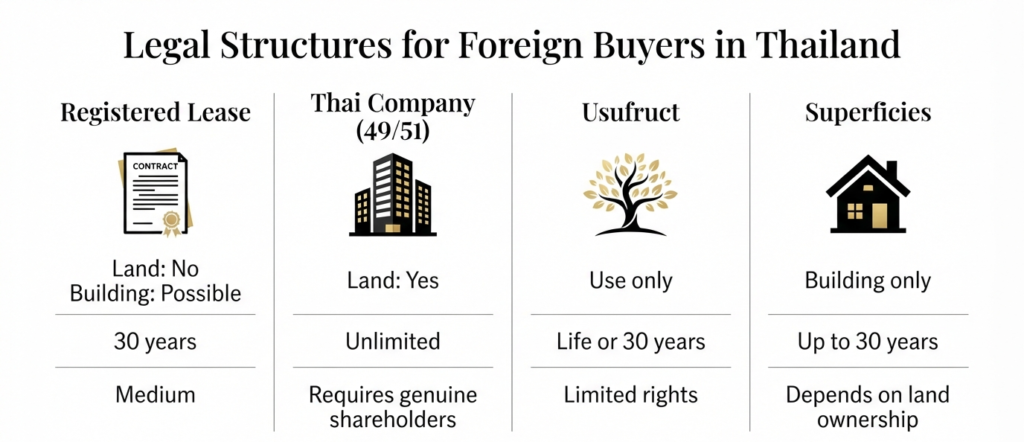
Foreign buyers cannot directly own land in Thailand, making the choice of legal structure a critical decision depending on the project and long-term objectives.
Title, company, permit: who handles what
Three separate administrations are involved, with no automatic coordination between them: the Department
of Lands manages titles and registration; the DBD oversees company structures; the OrBorTor (or Tessaban in urban areas) processes the building permit under the Building Control Act. The OrBorTor will refuse to
process an application if the title shows unvalidated boundary changes, if the applicant’s identity doesn’t
match the registered rights-holder, or if the plot’s zoning/altitude doesn’t match the submitted project. A
Thai company reclassified as “nominee” by the DBD after construction has started exposes the site to an
immediate stop-work order, regardless of the underlying land title’s quality.
What buyers hear — and what it actually means
| Phrase heard | What it actually means |
|---|---|
| “Almost a Chanote” | It doesn’t legally exist—it’s either a Chanote or it isn’t. Verify the exact document. |
| “Chanote in progress.” | The land has no Chanote at the time of sale. The upgrade process can take 6 to 24 months and isn’t guaranteed to succeed. |
| “Easy upgrade.” | Depends on the starting title, the topography, and neighbor cooperation during boundary surveys—rarely “easy” in practice. |
| “Buildable land” | An agent’s claim, not an administrative verification. Only the OrBorTor confirms actual buildability for a given project. |
Common investor questions
Can I resell easily? Liquidity depends directly on the title: a Chanote or Nor Sor 3 Gor resells without particular complication; a Nor Sor 3 requires a 30-day notice at every transfer and can discourage a buyer in a hurry.
Will a Thai bank finance the purchase? Local bank financing is rarely accessible to a non-resident foreign buyer without a Thai work permit; most transactions are funded in cash or financed from the buyer’s home country.
Will the land appreciate? This depends on local factors (access, zoning, and surrounding development) unrelated to the land title itself—a market analysis question, distinct from legally securing the plot.
Is a project profitable on this land? It depends on the combined cost (purchase + potential upgrade + zoning/access compliance + construction) relative to the intended project—precisely what a feasibility study addresses before purchase.
Private buyer, investor, developer: different priorities
| Profile | Verification priority |
|---|---|
| Private buyer (personal villa) | A title, access, ownership structure suited to long-term use |
| Investor (rental villa) | Title liquidity at resale, rental compliance, residential zoning |
| Developer (condominium) | 49% foreign ownership quota, FAR/OSR, large-scale company structure |
| Hotel / restaurant | Commercial zoning, operating licenses, public access, fire safety standards |
Real feasibility studies
The following cases are based on real projects reviewed by KZ Architecture & Design. Client identities have been generalized, and certain details adjusted to preserve confidentiality while accurately reflecting the technical and regulatory issues encountered.
Case 1 — “Almost a Chanote”
Location: Karon
Project: Hillside villa
Issue: A buyer arrived with a signed compromise for land marketed as “almost a Chanote.” Title verification revealed a Nor Sor 3 with unconfirmed boundaries.
Recommendation: Boundary clarification, or a renegotiated price factoring in upgrade cost and delay.
Result: The permit was submitted once the title was secured, with no unexpected block mid-project.
Lesson: “Almost a Chanote” is a marketing expression, not a legal classification.
KZ Method: Step 1 — Land Title Verification
Case 2 — A road that legally didn’t exist
Location: Koh Samui
Project: Private villa
Issue: Vehicles had used the access road for years, but no registered right-of-way existed. Project viability depended on neighboring landowners’ goodwill.
Recommendation: Postpone acquisition until legal access is secured.
Result: Still in progress — KZ continues to work with the client toward a resolution.
Lesson: An existing road is not the same as a registered legal right of access.
KZ Method: Step 4 — Access and Easements
Case 3 — Altitude restrictions identified before purchase
Location: Kamala
Project: Luxury hillside villa
Issue: The land lay within an altitude band where the proposed villa exceeded applicable development limits.
Recommendation: The client was advised not to proceed with the acquisition for that specific project.
Lesson: A legally owned plot is not necessarily a buildable one.
KZ Method: Step 3 — Zoning and Altitude
Case 4 — The land was legal; the project wasn’t
Location: Phuket hillside area
Project: High-end villa
Issue: The land title presented no concern, but the site’s natural slope exceeded the regulatory threshold for the intended development.
Recommendation: The client was advised against purchasing the land for this specific project.
Lesson: A compliant land title does not guarantee that a specific project can be approved.
KZ Method: Step 3 — Zoning and Altitude
Case 5 — The company structure that didn’t hold up
Location: Rawai
Project: Small condominium development
Issue: A 49/51 Thai company was proposed by the agent, with Thai shareholders recruited quickly for the transaction. The project was also reviewed against the 49% foreign condominium quota — a separate parameter from the land-holding structure.
Recommendation: Have the shareholder structure validated by a land lawyer before any commitment.
Result: The client restructured with genuine investor-shareholders before signing.
Lesson: A land title problem and a company structure problem are not the same risk, and both must be checked separately.
KZ Method: Step 5 — Ownership Structure
Checklist before you buy
- ☐ Title copy obtained directly from the provincial Land Office
- ☐ No mortgage or registered encumbrance confirmed
- ☐ Physical boundary confirmed on-site (surveyor if Nor Sor 3)
- ☐ Zoning and altitude verified (EPRA if hillside plot)
- ☐ Legal access confirmed — registered easement, not a verbal understanding
- ☐ Utility availability (water, electricity, sewage) verified
- ☐ Acquisition structure validated by a land lawyer (lease, company, usufruct)
- ☐ No funds transferred before effective registration at the Land Department
Our position
A Chanote works like a car’s title deed: it proves who owns the vehicle, not that it’s roadworthy. Anyone buying land in Phuket should involve understanding that title, zoning, access, and ownership structure are four separate checks, not one. Since establishing in Phuket, KZ Architecture & Design has built title and site
verification into every feasibility study, before the first sketch is drawn, not as a formality left to the buyer’s lawyer after design fees are already spent.
An error discovered after purchase can lead to significant delays, additional costs, and in some cases
call into question the feasibility of the project altogether.
A land purchase is never validated because of one document. It is validated only when the title, zoning, access, ownership structure, and intended project all work together.
What a successful land purchase looks like
- A Chanote, or a Nor Sor 3 Gor verified and understood for what it is
- Registered access, not a neighbor’s verbal tolerance
- Zoning and altitude confirmed as compatible with the intended project
- A project design that matches what the land can legally support
- A clean ownership structure, validated before signing — not after
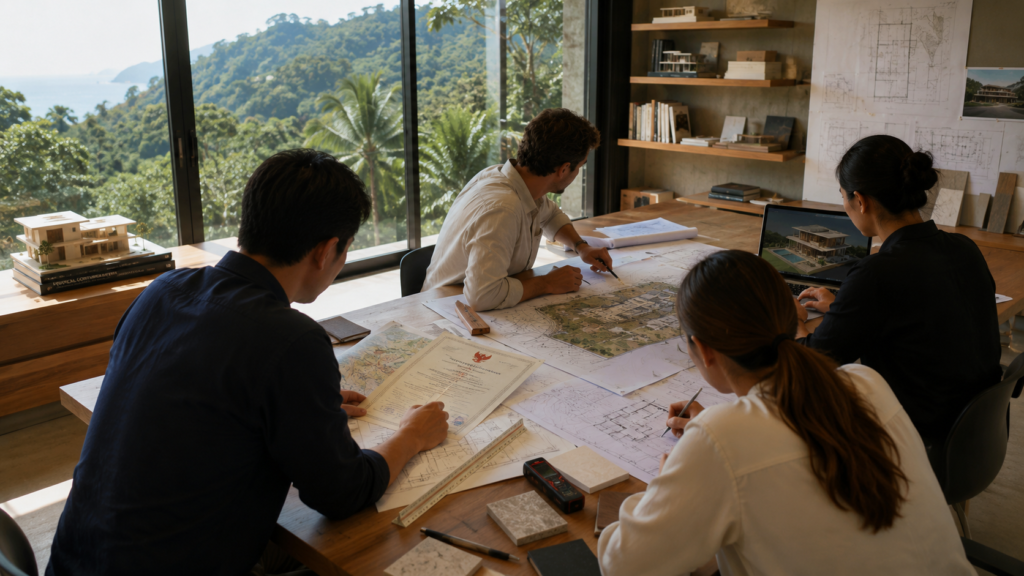
KZ Architecture and Design coordinates land verification, architectural planning, and permit preparation to reduce risk before construction begins.
Before you sign a compromise, get a feasibility study done. It represents a small fraction of the project
budget. It can prevent a loss worth several times its cost, land bought without the right to build, a title needing an upgrade, and an ownership structure that has to be redone.
Contact KZ Architecture & Design for a feasibility study before any financial commitment.
Frequently asked questions
Can a foreigner buy land in Thailand?
Not directly—the Land Code prohibits it. Legal options are a registered lease (30 years), a Thai company structure (49/51, with genuine shareholders), or usufruct/superficies.
How do you verify a chanote before buying?
By obtaining a copy directly from the Department of Lands (not through the agent), confirming there are no registered encumbrances, and having the physical boundary confirmed on site.
What’s the difference between Chanote and Nor Sor 3 Gor?
A Chanote guarantees full ownership with precise GPS-surveyed boundaries. A Nor Sor 3 Gor is a possessory right with aerial-surveyed boundaries—legally solid and upgradable to Chanote.
Can you build on Nor Sor 3 land?
Technically possible, but the risk of an administrative block at the permit stage is higher than with a Chanote or Nor Sor 3 Gor, due to boundary imprecision.
How much does a title upgrade to Chanote cost?
Official fees are marginal; the real cost is the private surveyor’s fee, typically between 50,000 and 120,000 THB depending on plot size and access (based on recent KZ Architecture & Design projects in Chalong, Rawai, and Kathu).
Risk summary
| Risk | Verified by | Authority | When | Impact if missed |
|---|---|---|---|---|
| Title type | Land lawyer / architect | Department of Lands | Before compromise | Blocked or delayed permit |
| Zoning / altitude | Architect / surveyor | MNRE, local OrBorTor | Feasibility study | The project cannot be built as planned |
| Access / easement | Land lawyer / architect | Land Office, OrBorTor | Before compromise | No legal right to reach the plot |
| Ownership structure | Land lawyer | DBD | Before company formation | Forced divestment, stop-work order |
| Permit compliance | Architect | OrBorTor / Tessaban | Before construction | Construction halted or fined |
Typical process timeline
Offer → Lawyer engaged → Architect feasibility study → Topographic and title survey → Zoning and ownership
structure confirmed → Purchase → Building permit application. Skipping the feasibility step and moving directly from offer to purchase is the most common source of the problems described in this guide.
Sources cited
Official legislation
- Department of Lands—Land Code Act B.E. 2497, Sections 86, 111-113, land title administration
- Civil and Commercial Code — Section 538 (lease registration), Section 540 (30-year cap)
- Building Control Act B.E. 2522 — Section 8 (ministerial regulations by zone/province)
Administrative guidance
- Ministry of Natural Resources and Environment — Protected Environmental Zone directives (revised December 2024)
- Department of Business Development — company registration, anti-nominee directives
Case law
- Supreme Court of Thailand, Decision No. 4655/2566 of 18 March 2025 (lease renewal clauses)
This article is for informational purposes only and does not constitute legal advice. Any land transaction
should be validated by a lawyer specialized in Thai land law before commitment.
Related articles: Complete Building Permit Guide for Foreign Buyers in Phuket · Leasehold vs Thai company for a construction project [link to be added] · BOQ and budget estimation [link to be added] · Feasibility study: what it actually covers [link to be added]
About the author
Kaled Kamala is the founder of KZ Architecture & Design, a licensed architecture firm based in Phuket, Thailand. A French architect (DPLG) graduated from the Paris-Val-de-Seine School of Architecture in 2004; he has 20 years of international experience, including 12 years across Asia, with a focus on tropical bioclimatic design, seismic construction, and complex regulatory environments.